
Productize Your CORE
Naval said find your specific knowledge. He forgot to tell you where to look.
Productize Your CORE
Naval Ravikant’s two-word career strategy, “Productize Yourself,” is one of the most cited frameworks in the builder internet. Find your specific knowledge (the thing only you can do). Attach leverage (code, media, capital). Escape competition through authenticity.
The framework is elegant. It is also incomplete. It tells you to find your specific knowledge. It does not tell you where to look.
Familiar Ground
You have heard the advice. Find what feels like play to you but looks like work to others. Build your personal monopoly. Escape competition through authenticity rather than through being slightly better at the same thing as everyone else.
Naval’s four-type leverage menu is clean:
| Leverage Type | Cost | Scale | Permission? |
|---|---|---|---|
| Labour | People management | Linear | Yes (hiring) |
| Capital | Access to money | Multiplicative | Yes (investors) |
| Code | Software | Infinite, identical output | No |
| Media | Content | Infinite, zero marginal cost | No |
Code and media are the democratised forms. No permission needed. No gatekeepers. A laptop and consistency is all it takes.
This is the part everyone quotes. The part everyone skips: the first word. “Yourself.” The framework assumes you already know who that is.
Counter-Signal
Most people cannot articulate their specific knowledge. Not because they lack it, but because they are looking in the wrong place.
They inventory their skills. Their credentials. Their experience. They list what they can do. But Naval explicitly says specific knowledge cannot be trained. It is not a skill. It is closer to an instinct, something you gravitate toward before anyone tells you to.
The gap is diagnostic. If you are searching through your resume for specific knowledge, you are looking at what the world has asked you to become. Not at what you already are. Skills are the output of your environment. Specific knowledge is the output of your identity.
⚛️ The Fusion
Two frameworks crash here, and the collision produces a map.
Naval’s specific knowledge has five properties. It cannot be trained. It feels like play, not work. It emerges from unusual combinations of domains. It creates a personal monopoly. And it is the thing you would do for free, which means the world has to pay you for it because it cannot get it elsewhere.
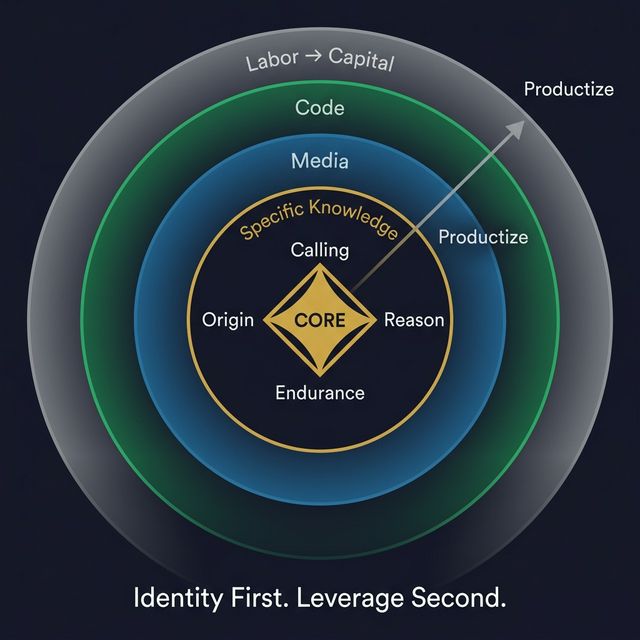
These five properties map precisely to an identity architecture. CORE (Calling, Origin, Reason, Endurance) is a framework that extracts the irreducible identity pattern beneath skills, roles, and credentials:
| Naval’s Property | CORE Element | Example |
|---|---|---|
| ”Feels like play, not work” | Calling: the activity you gravitate toward without instruction | Connecting patterns from unrelated domains |
| ”Emerges from unusual combinations” | Origin: the unique trajectory that gave you rare perspective | An outcast trajectory that collects patterns insiders miss |
| ”Cannot be trained” | Reason: the conviction that drives you beyond incentives | Belief that organisations are alive |
| ”Creates personal monopoly” | Endurance: the commitment that sustains you through resistance | Spreading the framework far and wide |
The collision is this: specific knowledge is not a thing you find. It is a thing you excavate. The archaeological expedition goes inward, through layers of socialisation, training, and credential accumulation, until you reach the irreducible pattern that was there before anyone told you what to become.
What if you could see your career not as a skill inventory but as a geological core sample, where the deepest layer is the one that matters most?
The 200-year reversal provides the historical context. The Industrial Revolution standardised labour: same input, same output, interchangeable workers. The Information Age began to reverse this: knowledge workers differentiated by what they knew. The AI Age completes the reversal: when every skill can be automated, the only defensible position is the identity that generated the skills in the first place.
Naval’s framework describes the economics. CORE describes the archaeology. You need both: the excavation to find your specific knowledge, and the leverage to productise it.
| Skills-First (The Resume) | Identity-First (The CORE) |
|---|---|
| “What can I do?" | "What am I drawn to without instruction?” |
| Lists credentials and experience | Excavates the pattern beneath credentials |
| Trainable, therefore replicable | Irreducible, therefore monopolistic |
| Changes with every job | Persists across every role |
| Competes on competence | Competes on authenticity |
| Asks: “What does the market want?” | Asks: “What would I do for free?” |
The New Pattern
The practical sequence: CORE first, leverage second.
Step one: excavate your CORE. What is your Calling (the activity that feels like play)? What is your Origin (the unusual trajectory that gave you rare perspective)? What is your Reason (the conviction beyond incentives)? What is your Endurance (the commitment that survives resistance)?
Step two: map your CORE to Naval’s leverage menu. Which leverage type amplifies your specific knowledge? If your Calling is connecting patterns (a Transmuter), media leverage (books, articles, visual frameworks) amplifies it: you write once, the pattern reaches millions. If your Calling is building systems, code leverage amplifies it: you build once, the system operates at scale.
Step three: productise. Not yourself as a brand. Your CORE as a value system that operates independently of your presence. The book teaches without you in the room. The software serves without you at the keyboard. The framework guides decisions without you at the table.
The test: can someone benefit from your specific knowledge when you are asleep?
The Open Question
Naval said: “Productize Yourself.”
But “yourself” is not your skills, your resume, or your credentials. Those are the sediment. Beneath them is the bedrock.
Have you excavated far enough to find it?
This fusion emerged from a STEAL on Linas Beliunas’ synthesis of Naval Ravikant’s framework, bridging Naval’s leverage economics with identity architecture to reveal where specific knowledge actually lives.