
She Banned AI
An NYU professor replaced laptops with $1 notebooks. She fixed the symptom. The disease is older than AI.
She Banned AI
An NYU professor could not tell which papers were written by students and which were written by machines. So she banned laptops, bought her students one-dollar notebooks from Amazon, and called it a win.
Eleven thousand people liked the post. Almost nobody asked the obvious question.
Familiar Ground
You know the professor’s frustration. It is real. She reads a submission and cannot tell if a human wrote it. The sentences are too polished, too structured, too clean for an undergraduate who is learning English as a second language. She does not want to approach every student with suspicion. She does not want to run every paper through a detector that is wrong half the time.
So she removed the variable. No laptops. No typed papers. Handwritten notebooks only. The scribbles, cross-outs, and misspellings returned. She could see the thinking again. Problem solved.
Except it is not the problem.
Counter-Signal
The professor changed the delivery medium. She did not change what she was measuring.
If your assessment can be completed by an AI without any understanding of the material, the assessment is testing reproduction, not comprehension. A student who copies a textbook by hand has not learned the textbook. A student who copies AI output by hand has not learned the subject. The medium is irrelevant. The assessment design is the failure point.
The professor herself reveals this when she says: “Even if a couple of students feed the questions to the AI and then write the generated answers by hand, that’s a win for me.” She is conceding that engagement with AI output has pedagogical value while simultaneously banning it. The logic fractures under its own weight.
Handwriting proves authorship, not understanding. You can write soulless prose by hand and profound thought with AI assistance. Authenticity is not a property of the medium. It is a property of the mind that produced the work.
⚛️ The Fusion
Three patterns crash here, and the wreckage looks familiar.
The fifty-year prohibition cycle repeats with metronomic reliability. Calculators in the 1970s: “Students will not learn maths.” The internet in the 1990s: “Students will plagiarise.” Wikipedia in the 2000s: “Unreliable source, ban it.” Smartphones in the 2010s: “Too distracting, confiscate them.” Every time, the technology won. Not because prohibition failed mechanically, but because the world outside the classroom kept using the tool. The students who learned with it were better prepared than the students who were shielded from it.
GenAI is the 2020s entry in the same ledger. The professor who bans it is not wrong about the disruption. She is wrong about the direction of the response.
The MBS diagnostic (a framework for distinguishing Mind, Body, and Soul interventions) exposes the structural error. Switching from typed papers to handwritten notebooks is a Body intervention: you changed the physical medium. But the root cause lives in the Soul layer. Students cheat because they do not know why they are writing the paper. They see the assignment as a performance requirement, not a learning opportunity. This is purpose amnesia: the founding reason was never transmitted.
What if you could see the difference? A Body fix changes the surface. A Soul fix changes the reason. The professor replaced the calculator. She did not teach mathematics.
Control dressed as trust completes the collision. The professor frames her intervention as “restoring trust.” But the mechanism reveals the opposite:
Suspicion leads to tool removal, which leads to forced authenticity, which produces “trust” by elimination, not by choice.
This is not trust. Real trust requires acknowledging AI, redesigning assessment so students choose integrity when they could easily cheat, and then trusting the choice. Trust built by subtraction is control wearing a different name.
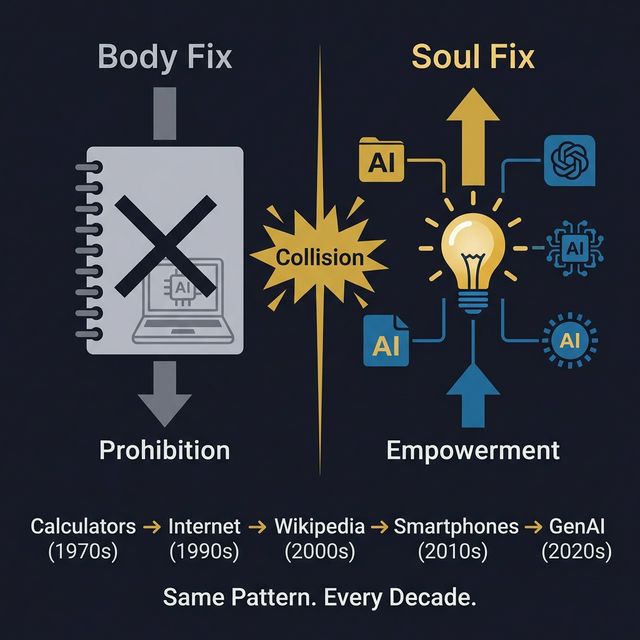
| The Notebook Retreat (Body Fix) | The Empowerment Model (Soul Fix) |
|---|---|
| Remove the tool | Teach how to use the tool |
| Change the medium (digital → paper) | Change the assessment (reproduction → comprehension) |
| Trust by subtraction | Trust by partnership |
| Student as suspect | Student as collaborator |
| Prepares students for a world without AI | Prepares students for a world with AI |
| Scales to 30 students | Scales to millions |
The New Pattern
The diagnostic is transferable. Every time you encounter disruption, ask: is this a Body fix or a Soul fix?
Organisations do this constantly. A team is underperforming, so you restructure (Body). But the team does not know why they exist (Soul). You install a new project management tool (Body). But nobody agrees on what success looks like (Soul). You ban personal devices in meetings (Body). But the meetings have no purpose worth paying attention to (Soul).
The professor’s mistake is not unique to education. It is the default human response to complexity: change something visible and concrete because the invisible, structural problem is harder to name.
The question for education is not “how do we prevent students from using AI.” The question is “why are students submitting work they do not care about, and how do we make the work worth caring about?”
An assessment that requires Socratic dialogue, oral defence, portfolio progression, or project presentation cannot be completed by AI alone. Not because AI is incapable, but because these formats test understanding, which requires a human who understands. Redesign the assessment and the “cheating” problem disappears. Not because you banned the tool, but because you made the tool irrelevant to the thing you are actually measuring.
The Open Question
The professor bought her students one-dollar notebooks to solve a trust problem that technology did not create.
What problem in your organisation are you solving with a Body fix, when the disease lives in the Soul?
This fusion emerged from a STEAL on Roya Shahidi’s Business Insider article (9 March 2026) documenting Professor Ayşe Baltacıoğlu-Brammer’s classroom notebook retreat at NYU.