The Intelligence Layer Swallowed Integration
MCP was supposed to be the USB for AI. Sixteen months later, the models learned to read.
The Intelligence Layer Swallowed Integration
Sixteen months ago, Anthropic launched MCP and called it “the USB for AI.” One standard protocol. Every tool plugs in. The pitch was clean, logical, and wrong.
On March 11, 2026, Perplexity’s CTO Denis Yarats stood on stage at the Ask conference and said what builders had been muttering for months: MCP is dead. Not deprecated, not evolving. Dead.
Familiar Ground
You know this pattern. A new standard emerges. A community rallies. Tutorials appear. Integrations proliferate. And then, quietly, the thing the standard was standardising learns to do the job itself.
MCP was an integration layer. It sat between your AI model and the tools it needed to use: databases, APIs, file systems, third-party services. The model spoke MCP. The tool spoke MCP. Everyone was happy.
Except nobody asked what happens when the model stops needing a translator.
Counter-Signal
Yarats named three kill shots. Each one alone would be a warning. Together, they are a verdict.
The Token Tax. Every MCP interaction starts with the model reading a schema: tool descriptions, parameter definitions, type specifications. This consumes 15 to 20 percent of the context window before any useful work begins. In a world where tokens are your most expensive resource, you are paying rent on a room you never enter.
The Auth Nightmare. Every MCP server is its own authentication endpoint. OAuth handshakes per server. Session management per connection. Credential rotation per tool provider. At scale, with a hundred or more tools, this is not integration. It is a maintenance burden disguised as a protocol.
Model Literacy. This is the real one. In 2023, treating LLMs as toddlers who needed a universal translator was reasonable. By 2026, these models write complex Python, navigate REST APIs from documentation alone, and use CLIs better than most junior developers. The toddler graduated. The translator is still charging tuition.
⚛️ The Fusion
Three ideas crash here, and the debris reveals a pattern older than software.
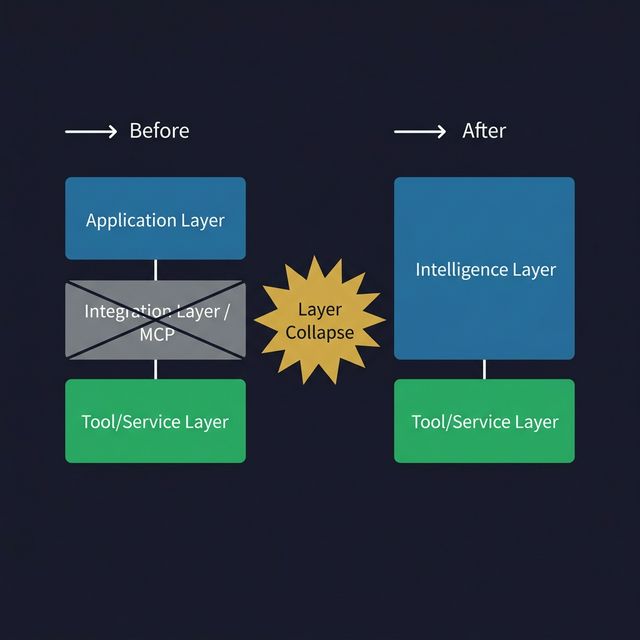
Layer Collapse is what happens when a system becomes capable enough to perform its intermediary’s function. The intermediary dies. Not because it was badly built, but because it was built for a version of reality that no longer exists. Smartphones did this to cameras, maps, and music players. The phone did not replace them by being better at each function. It replaced them by making the standalone device unnecessary.
MCP is the standalone device. The Intelligence Layer is the smartphone.
The Token Tax turns this from a theoretical pattern into an economic inevitability. A 15 to 20 percent overhead is tolerable when there is no alternative. The moment models can call APIs directly, the tax becomes a competitive disadvantage. You are not paying for integration. You are paying for legacy.
The Agent Substrate is the inversion that follows. MCP asked: “How do we make all tools speak one language?” The Agent Substrate asks the opposite question: “How do we make every system instantly understandable to any powerful AI?” The answer is not a new protocol. The answer is what already exists: CLIs, REST APIs, man pages, OpenAPI specs. Documentation becomes the interface. The model reads it directly. No middleware. No translation. No tax.
What if you could see your architecture as a layer diagram and ask: which layer is about to be swallowed by the one above it?
| MCP (The Old Pattern) | Agent Substrate (The New Pattern) |
|---|---|
| Tools conform to one protocol | Every system becomes AI-readable |
| Model reads schema, then acts | Model reads docs, then acts directly |
| 15-20% token tax per interaction | Near-zero integration overhead |
| Each server: separate auth endpoint | Existing auth (OAuth, gRPC) reused |
| New standard replaces old standards | Existing standards survive (“cockroaches”) |
| Middleware adds a dependency layer | No middleware, no dependency chain |
The New Pattern
The lesson is not about MCP. It is about Layer Collapse as a diagnostic tool.
Every architecture has layers. Some of those layers exist because a capability gap made them necessary. When the gap closes, the layer dies. It does not evolve. It does not adapt. It collapses into the layer that absorbed its function.
Ask three questions of any integration layer in your stack:
- Does the system above this layer now have the capability to perform this layer’s function directly?
- Is the overhead of maintaining this layer greater than the cost of direct access?
- Is the trend moving towards more capability above, or more complexity below?
If all three answers point upward, your integration layer is already dying. You just have not admitted it yet.
The convergence is striking. On the same day this research was captured, three separate sources pointed in the same direction: a practitioner proved that shell commands outperform typed tool schemas, a vendor (OpenAI) shipped an agent loop built on shell execution, and an industry leader (Perplexity) declared the typed integration protocol dead. Three altitudes of evidence. One conclusion.
The battle-tested protocols, OAuth, gRPC, REST, are what Yarats calls “the cockroaches of the tech stack.” They survive everything. Not because they are elegant, but because they are proven. The next architecture is not built on a new standard. It is built on the standards that refused to die.
The Open Question
Your architecture has layers. Some of them were built for a world where AI could not read.
AI can read now.
Which layer in your stack is the next MCP?
This fusion emerged from a STEAL on the MCP Death event at Ask 2026, capturing Denis Yarats’ (CTO, Perplexity) public declaration alongside two convergent industry signals from the same day.