
The One-Person Unicorn
Sam Altman and Dario Amodei both predict a solo billion-dollar founder. The bottleneck is not the AI. It's the operating system.
The One-Person Unicorn
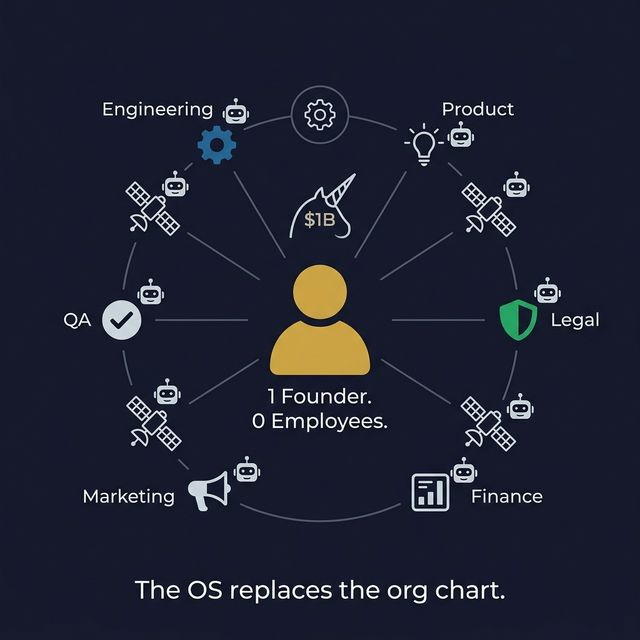
Sam Altman and Dario Amodei do not agree on much. They disagree on safety approaches, business models, and the timeline for AGI. But both CEOs of the world’s leading AI labs have made the same prediction: a one-person, billion-dollar company is coming.
Not a small business. Not a lifestyle company. A billion-dollar enterprise built by a single founder with AI agents instead of employees.
The prediction is credible. The unstated assumption is not.
Familiar Ground
You can see the pieces. A solo founder today can produce software with AI coding agents, generate marketing content with AI writers, handle customer support with AI chatbots, manage finances with AI analytics, and conduct legal review with AI contract analysis. Every department of a traditional startup has an AI equivalent.
The math is stark. What used to be headcount lines on a budget are now API calls. An entire engineering team: prompts. A marketing department: prompts. Legal review: prompts. The cost structure of a startup collapsed from millions in salaries to thousands in compute.
VCs have not caught up. They are still underwriting headcount. The solo founder who understands this builds a compounding moat while the funded competitor builds a burn rate.
Counter-Signal
But having access to AI agents for every function is not the same as running a company. A startup is not a collection of departments. It is a system where departments coordinate, where decisions propagate across functions, where quality standards are enforced, and where conflicts between priorities are resolved.
A solo founder with twenty agents and no coordination system has twenty independent contractors who do not talk to each other. The engineering agent builds a feature the product agent did not specify. The marketing agent promotes a capability the engineering agent deprecated. The legal agent flags a risk nobody else has seen.
The agents are capable. The orchestra has no conductor.
⚛️ The Fusion
Two assumptions crash here, and the collision reveals the real bottleneck.
The capability assumption says the AI needs to get smarter. Better models, larger context windows, more sophisticated reasoning. This is the investment thesis behind every AI lab. And every generation of models proves them right: each release is more capable than the last.
The governance assumption says something different. The AI is already capable enough. The bottleneck is not intelligence. It is orchestration: how agents coordinate, how decisions are audited, how quality compounds instead of degrading, how knowledge persists between sessions.
The first solo unicorn will not be the founder with the most powerful models. It will be the founder with the best operating system: the governance harness that makes twenty agents function like a coherent enterprise.
| Traditional Startup (20 people) | Solo Unicorn (1 founder + OS) |
|---|---|
| CEO sets strategy | Founder defines constraints and goals |
| Middle managers coordinate | OS orchestrates agent workflows |
| QA team audits quality | Automated quality gates audit every output |
| HR enforces culture | Governance protocols enforce standards |
| Meetings resolve conflicts | Dialectic protocols surface and resolve disagreements |
| Knowledge lives in people’s heads | Knowledge graph persists across every session |
| Company runs when CEO is absent | System runs when founder is asleep |
The New Pattern
The diagnostic question for every solo founder: do you have an OS, or do you have a collection of tools?
Tools solve individual tasks. An OS solves coordination. The difference is the difference between a garage full of power tools and a factory. The garage has capability. The factory has a system.
The OS for a solo unicorn needs five components:
Strategic governance: a decision framework that prevents the founder from making every decision manually. When the engineering agent and the marketing agent disagree on priority, the framework resolves it without human intervention.
Quality architecture: automated gates that audit every output before it ships. Not manual review (that does not scale to a solo founder). Automated checks that enforce the standard.
Multi-agent dialectic: a mechanism for agents to challenge each other’s assumptions. Without adversarial review, AI agents converge on comfortable answers. With it, they stress-test each other and the output is stronger.
Persistent knowledge: a memory system that accumulates across sessions. The insight from Monday’s coding session is available to Wednesday’s marketing planning. Knowledge compounds instead of evaporating.
Audit trail: a record of every decision, every output, every quality gate. Not for compliance. For compound learning: the system gets better because it can see what it has done before.
The solo founder who builds this OS has something no funded competitor can easily replicate: a compound intelligence machine that gets smarter with every task, operates while they sleep, and scales without headcount.
The Open Question
Altman and Amodei agree: one person, one billion dollars.
The models are ready. The tools exist. The cost structure works.
The question neither CEO has answered: who builds the operating system that makes twenty AI agents function like a company, and what does it look like?
This fusion emerged from a STEAL on the One-Person Unicorn thesis, tracking the convergence between AI lab predictions and the governance gap that determines which solo founder actually gets there.