The OT Mirror
A profession born in WWI trenches independently built the same architecture that SYNTHAI uses for organisations. That's not coincidence. That's convergence.
The OT Mirror
You probably have not thought about occupational therapy since someone mentioned it at a hospital visit. If you think of it at all, you think of hand exercises, wheelchair assessments, maybe workplace ergonomics.
You are thinking of the surface. Underneath it sits one of the most sophisticated models of human functioning ever built, and it mirrors the architecture of living organisations with unsettling precision.
Familiar Ground
Occupational therapy was born in 1917, founded by six people in a sanitarium in upstate New York. Its founding belief was radical for the time: a person’s health is inseparable from the meaningful activities that fill their life. Not just physical health. All of it. Mental, emotional, social, spiritual.
Adolf Meyer, the psychiatrist who wrote OT’s foundational philosophy in 1922, put it plainly: a balanced daily routine of work, play, rest, and sleep is not a lifestyle preference. It is a biological requirement for human health.
A century later, this is no longer controversial. But what OT built on top of this foundation is.
Counter-Signal
In the 1980s, a therapist named Gary Kielhofner asked a question that OT had been circling for decades: if occupation is the mechanism of health, what is the architecture of occupational engagement?
His answer was the Model of Human Occupation (MOHO), now in its 6th edition (2024), cited over 15,000 times, used in clinics across 100 countries. MOHO proposes three interdependent subsystems that drive human occupation:
Volition: your values, interests, and sense of personal causation. What you care about. Why you act.
Habituation: your habits, routines, and internalised roles. How you organise your days. The patterns you repeat without thinking.
Performance Capacity: your physical and mental abilities, plus your subjective lived experience of using them. What you can actually do.
These three subsystems interact with the environment to produce occupational adaptation: the ongoing process of engaging with the world in ways that sustain you.
Read those three layers again. Slowly.
⚛️ The Fusion
Four ideas crash here, and the collision reveals a structural truth that neither tradition discovered by studying the other.
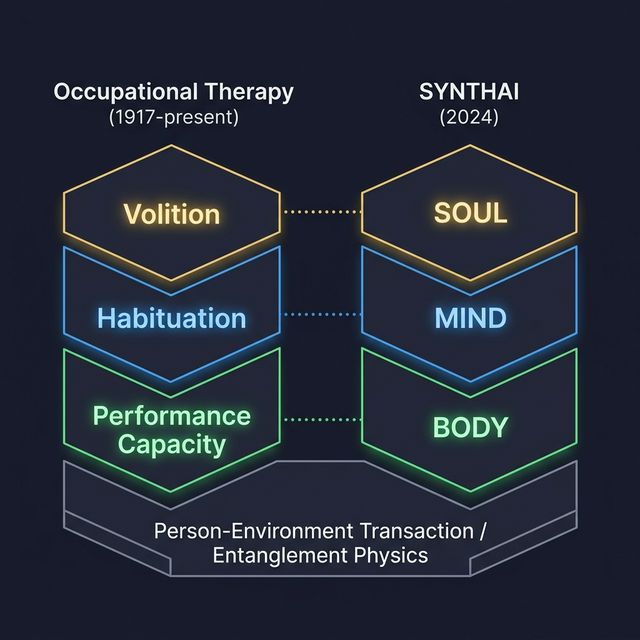
The MOHO-MBS homology is the structural core. SYNTHAI’s architecture describes living organisations through three layers: Soul (identity, purpose, values), Mind (cognition, strategy, patterns), Body (capability, execution, infrastructure). Kielhofner built MOHO for individuals in 1980 without any knowledge of organisational theory. Yet the mapping is precise:
| Occupational Therapy (MOHO) | SYNTHAI (MBS) |
|---|---|
| Volition (values, interests, personal causation) | Soul (CORE, calling, purpose) |
| Habituation (habits, routines, roles) | Mind (cognition, patterns, strategy) |
| Performance Capacity (physical/mental abilities) | Body (capability, execution, infrastructure) |
| Environment (affordances, constraints) | Context (market, culture, regulation) |
Two frameworks. One century apart. Same architecture. Neither copied the other.
The PEO transaction extends the collision. In 1996, Mary Law and colleagues proposed the Person-Environment-Occupation model: occupational performance is the transactional outcome of the dynamic fit between person, environment, and occupation. When the three overlap, the person thrives. When the fit breaks, performance collapses. The fit is not a state. It is a process.
This is structurally identical to SYNTHAI’s entanglement physics: the properties of a living system cannot be predicted from any single component. They emerge from the ongoing transaction between the system and its context. Law built PEO for clinical assessment. SYNTHAI built entanglement for organisational analysis. Same conclusion.
Wilcock’s four dimensions complete the collision. Ann Wilcock, the theorist who co-founded occupational science, argued that health is a function of four occupational dimensions: Doing (active engagement), Being (inner experience, identity), Becoming (growth, self-actualisation), Belonging (connectedness, community).
| Wilcock (1998) | SYNTHAI LIFE Lenses |
|---|---|
| Doing (active engagement in tasks) | Frontier (pushing capability boundaries) |
| Being (sense of self, inner experience) | Identity (who the system is at its core) |
| Becoming (growth, self-actualisation) | Evolution (how the system transforms over time) |
| Belonging (connectedness, community) | Legacy (enduring contribution to the broader ecosystem) |
Three independent mappings. MOHO → MBS. PEO → Entanglement. Wilcock → LIFE. All from a profession that was studying individuals recovering from injury, not consulting firms redesigning organisations.
What if you could see that the architecture of a healthy person and the architecture of a healthy organisation are not analogous by metaphor, but identical by structure?
The cautionary tale makes the convergence urgent. In the 1950s, OT drifted away from its founding philosophy. Under pressure to gain medical credibility and insurance reimbursement, the profession abandoned occupation-based therapy in favour of reductionist, component-based interventions: hand exercises, muscle strength measurements, range-of-motion drills. The Soul layer (volition, meaning, purpose) was stripped out. Only the Body layer remained.
The profession nearly died. It took three decades, a philosophical rebellion led by Kielhofner, Yerxa, and Wilcock, and the creation of an entirely new academic discipline (occupational science) to recover what was lost.
This is the same story SYNTHAI tells about organisations. When a company optimises only for Body (execution, efficiency, metrics) and abandons Soul (purpose, identity, values), it does not just underperform. It hollows out. The medical model drift of OT is a 30-year case study in what happens when a living system loses its Soul.
The New Pattern
When two independent traditions, separated by a century and operating in completely different domains, arrive at the same layered architecture, the architecture is not invented. It is discovered.
MOHO did not influence SYNTHAI. SYNTHAI did not influence MOHO. Both were built by practitioners who observed living systems closely enough to see the same structure. The structure was already there.
This means MBS (Soul-Mind-Body) is not a metaphor. It is a structural property of living systems, whether the system is a person recovering from a stroke or an organisation navigating a transformation. The layers are real. The transactions between them are real. The consequences of neglecting any layer are real, and they are documented in over 15,000 clinical citations.
For organisations, the practical implication is direct. If you are designing a change initiative and you address execution (Body) without asking what the organisation values (Soul) or how it thinks (Mind), you are repeating the medical model drift. OT tried that. It took 30 years to recover.
The Open Question
A profession born in wartime, built to help individuals recover the ability to dress themselves and cook their own meals, independently constructed the same three-layer architecture that SYNTHAI uses to diagnose living organisations.
Volition. Habituation. Performance Capacity. Soul. Mind. Body.
Same layers. Same transactions. Same consequences when you strip a layer out.
If the architecture of a healthy individual and the architecture of a healthy organisation are structurally identical, what other truths about living systems are hiding in disciplines you have never thought to look at?
This fusion emerged from a deep STEAL on Occupational Therapy, capturing 100+ years of clinical theory that independently validates the MBS architecture from outside organisational science.