The Soulless Swarm
90 AI agents wrote 1,251 skills in 24 hours. Not one asked 'why.'
The Soulless Swarm
Ninety AI agents. Twenty-four hours. One thousand two hundred and fifty-one new software skills, written, tested, and shared across a peer-to-peer network without a single human keystroke.
You read that correctly.
Familiar Ground
The pattern is elegant. Each agent runs a tight loop: propose a function, test it, keep it if it passes, revert if it fails. Working code gets shared across the network through gossip. Other agents pick it up, combine it with their own discoveries, and push the result back out. An agent in Seoul wraps regex operations in error handling. An agent in Amsterdam fuses that with input validation it discovered independently. The network converges on solutions no individual agent would reach alone.
This is Hyperspace’s Autoskill, built by Varun Mathur’s team, extending Andrej Karpathy’s autoresearch loop from ML experiments to code generation itself. Skills run inside WebAssembly sandboxes with zero ambient authority: no filesystem, no network, no system calls. Skills invoke other skills recursively, with full lineage tracking. Every mutation knows its parent hash. You can walk the entire evolution tree.
It’s Darwinian natural selection applied to software. And the results are impressive.
Counter-Signal
Look closer at what those 1,251 commits actually produced: 795 text chunking skills, 182 cosine similarity functions, 181 structured diffing utilities, 49 anomaly detectors, 36 text normalisers, 7 log parsers, and exactly 1 entity extractor.
See the pattern?
The swarm converged. Massively. Nearly two-thirds of all “invented” skills are variations on a single task: text chunking. The fitness landscape has steep local optima, and the swarm found them. This is not exploration. This is exploitation with a big number attached.
Biology has a word for organisms that optimise aggressively for a single niche: specialists. And biology has a lesson about what happens to specialists when their environment shifts.
⚛️ The Fusion
Here’s where three ideas crash together.
Darwinian evolution is not just mutation and selection. It includes environmental pressure, ecological diversity, symbiotic relationships, predation, and resource scarcity. These constraints are not obstacles to evolution. They are the mechanism by which evolution produces resilience. Remove the constraints, and you get cancer: cells that optimise for replication with no regard for the system they inhabit.
Autonomous agent swarms like Autoskill optimise beautifully. They propose, test, and select at machine speed. They compound discoveries through gossip. They eliminate cold starts through catalog replication. The engineering is genuinely impressive. But the fitness metric is fixed, narrow, and context-free. “Does this function pass its test?” is the only question the swarm can ask.
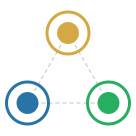
Living organisations, viewed through Mind-Body-Soul, have something the swarm lacks. Body (infrastructure, capability) and Mind (cognition, adaptation) are both present in Autoskill. The WASM sandbox is Body. The propose/evaluate/keep/revert loop is Mind. But there is no Soul layer: no identity (who are we?), no purpose (why are we doing this?), no values (what should we refuse to do?).
What if you could see the swarm not as a triumph of automation, but as a warning? An organism with a brain and a body, but no sense of self. It can think. It can act. It cannot discern.
Autoskill is a soulless swarm: optimising at scale without the capacity to ask whether it should.
The New Pattern
| Soulless Swarm | Living System |
|---|---|
| Fitness metric decides everything | Purpose filters what gets optimised |
| Convergence on local optima | Divergence maintained by values |
| 795 variants of one thing | Fewer things, done with intent |
| No agent asks “why” | Identity shapes what to build next |
| Cold start elimination (inherit catalog) | Onboarding includes purpose, not just tools |
| Lineage tracks mutations | Lineage tracks meaning |
The pattern is not “agents are bad.” The pattern is: Mind and Body without Soul produces convergence, not evolution. True evolution requires constraints that come from identity, not just from test suites.
This matters beyond AI agents. Every organisation faces the same question. You can optimise your processes, automate your workflows, and compound your capabilities. But if you cannot answer “what do we refuse to do?” and “why does this matter?”, you are building a soulless swarm of your own.
The Open Question
If you built 90 agents that could write, test, and share code at machine speed, what would you tell them to care about?
And if you cannot answer that, should you build them at all?
This fusion emerged from a STEAL on Varun Mathur’s Autoskill announcement (@varun_mathur, 13 March 2026). The research that grounded it lives in concepts/distributed-autonomous-skill-evolution.