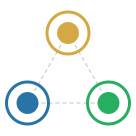
Trust Asymmetry
The demand is always: trust us. The action is always: we don't trust you.
Trusting a stranger without discernment brings endless suffering. Valluvar warns against blind trust. But your organisation has the opposite problem: it demands trust from people it actively distrusts. “Trust the process,” says the leader who reviews every output. “We’re a family,” says the company that monitors your keystrokes. “I have an open door,” says the VP whose calendar is impossible to access. Trust flows upward. It never flows back down. The demand is always: trust us. The action is always: we don’t trust you.
Morning Star, the world’s largest tomato processor, has no managers. I read the research three times before I believed the model. Every employee writes a ‘Colleague Letter of Understanding,’ a contract not with the company but with every other employee they work with. Compensation is determined by a committee of peers who review each person’s contribution. Any employee can audit any other employee’s pay. Trust asymmetry, where the boss knows everything and the worker knows nothing, is structurally impossible. The anti-pattern is radical: instead of trusting management, trust the people who actually do the work.
Trust asymmetry violates thermodynamics. In physics, thermal equilibrium occurs when heat flows from a warmer body to a cooler one until both reach the same temperature. The flow is inherently bidirectional. Nature enforces balance. Organizational trust refuses to equalize. Leadership expects trust from teams. Teams extend it. Leadership withholds trust from teams. The flow never reverses. This isn’t equilibrium. It’s a one-way valve: trust flows in, oversight flows out. And systems with one-way valves eventually build pressure until something ruptures.
Before you next ask your team to trust a decision, ask yourself: when was the last time you trusted one of theirs? Not endorsed it after review. Not approved it through a process. Trusted it. Without verification. Because you trusted them. If you can’t remember, the asymmetry is structural.
That one-way valve has a name. Trust Asymmetry. And once you see it, you can’t unsee it.
Untie The Knot
Uproot
Trust asymmetry formed from hierarchy itself. Power created the assumption that senior people had earned trust and junior people hadn’t yet. The error: trust was treated as a status marker, not a relational practice. The higher you rose, the more trust you received and the less you were expected to give.
Navigate
Trust flows bidirectionally. Leaders trust their teams’ judgment with the same confidence they expect for their own decisions. The flow equalizes.
Tool
SPAR / Dialectic: the protocol that structures trust exchange by making all perspectives (regardless of rank) equally weighted in deliberation. SPAR forces bidirectional engagement.
Implement
Before you next ask your team to trust a decision, ask yourself: when was the last time you trusted one of theirs, without verification, without review, because you trusted them?
Emerge
When trust flows both ways, the team stops performing compliance and starts contributing discretionarily, communication becomes honest instead of strategic, and hierarchy becomes a structure, not a wall.