Decision Fragmentation
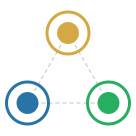
Each decision was rational in isolation. Together, they created three incompatible systems, three duplicated budgets, and three teams who discovered each other at the integration meeting.
Those who know the weight of words speak only after understanding the full assembly. Valluvar insists: understand the whole before contributing a part. Three teams in your organisation made the same decision last quarter. Differently. Team A chose vendor X. Team B chose vendor Y. Team C built it in-house. Nobody knew the others were deciding. Nobody asked. Nobody checked. Each decision was rational in isolation. Together, they created three incompatible systems, three duplicated budgets, and three teams who discovered each other at the integration meeting.
Before Satya Nadella, Microsoft was governed by what employees called ‘the veto culture.’ I found internal blog posts describing how shipping a single feature required navigating the political interests of Windows, Office, Server, and Azure divisions. Each VP could block any initiative that threatened their revenue line. Steven Sinofsky controlled Windows like a sovereign state. The result was that Microsoft missed mobile, missed social, and nearly missed cloud. Innovation didn’t die from lack of ideas. It died from an excess of people empowered to say no.
Fragmented decisions scatter energy like scattered files scatter performance. In computing, disk fragmentation occurs when files are stored in non-contiguous blocks across a hard drive. Each file is complete. Each block is valid. But reading them requires the system to jump between scattered locations, dramatically slowing performance. Organizational decision fragmentation works the same way: each local decision is sound. But when the organisation tries to operate as a whole, it’s jumping between contradictory commitments, incompatible systems, and duplicated investments. The decisions aren’t wrong. They’re scattered. And scattered decisions produce the same result as no decisions: incoherent action.
Before making any decision with cross-team implications, ask one question: ‘Who else is deciding something similar right now?’ If you don’t know, find out before you commit. Ten minutes of discovery saves ten months of integration pain.
That scattered architecture has a name. Decision Fragmentation. And once you see it, you can’t unsee it.
Untie The Knot
Uproot
Decisions fragmented because the organizational surface area exceeded its coordination capacity. Three teams faced the same choice without any mechanism to discover each other. The structure made fragmentation inevitable.
Navigate
Before any decision with cross-team implications, the decision-maker identifies who else is deciding something similar. Discovery precedes commitment.
Tool
DMG / Decision Map: the visual representation of in-flight decisions across the organisation. When decisions are mapped, fragmentation becomes visible before it produces duplication.
Implement
Before making any cross-team decision, ask: who else is deciding something similar right now? Ten minutes of discovery saves ten months of integration.
Emerge
When decisions are visible across teams, duplication drops, resources consolidate, and the organisation starts making coherent choices instead of contradictory local ones.