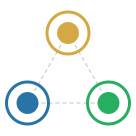
Learning Doing Imbalance
Both imbalances produce the same result: no growth.
Learn thoroughly. Then live by that learning. Valluvar connects learning to action. Both are required. Your team shipped 47 features last quarter. They repeated three mistakes from last quarter. The doing is happening. The learning isn’t. Or the inverse: your team attended twelve training sessions, read four books, and completed two certification programs. They shipped nothing new. The learning is happening. The doing isn’t. Both imbalances produce the same result: no growth.
Foxconn employs 1.2 million people. I read the academic research on its Shenzhen facilities. Workers perform a single repetitive task for 10-12 hour shifts. Training is operational, not developmental: learn this motion, repeat it 400 times per hour. The Learning-Doing imbalance is structural. Foxconn’s model requires doing without learning because learning creates expectations, and expectations create demands. The suicide nets installed on factory buildings in 2010 are the physical manifestation of a capability model that treats human beings as single-function machines.
Harvest without composting depletes the soil. In agriculture, continuous harvesting without returning nutrients to the soil depletes it. Each season produces less. The farmer is still working. The soil is still there. But the yield declines because the cycle is broken. Organizational learning-doing imbalance works identically: continuous shipping without reflection depletes the team’s capability. Each sprint produces output. But the quality declines because the learning cycle is broken. Conversely, continuous learning without shipping depletes relevance. The team knows more. But the knowledge has no application, no feedback, no test.
After every sprint, protect 30 minutes for one question: what did this sprint teach us? Not what was shipped. What was learned. If nothing was learned, the next sprint will repeat this one’s mistakes.
That broken cycle has a name. Learning-Doing Imbalance. And once you see it, you can’t unsee it.
Untie The Knot
Uproot
Imbalance formed because doing was measured and learning wasn’t. Sprints counted features. Nobody counted lessons. Velocity was visible. Growth was invisible.
Navigate
Every sprint includes a protected learning review: one question answered, one pattern identified, one lesson documented.
Tool
CORE / Reason: the diagnostic that measures the balance between doing and understanding. Reason prevents execution from outrunning comprehension.
Implement
After every sprint, protect 30 minutes for: what did this sprint teach us? If nothing was learned, the next sprint repeats this one’s mistakes.
Emerge
When learning and doing are balanced, quality improves, mistakes stop recurring, and the organisation builds capability alongside output.