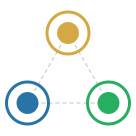
Turnover Spiral
Each departure increased the load on those remaining. Each increased load reduced the reason to stay. The spiral has its own gravity.
Greatness comes to those who persevere and gain clarity. Valluvar rewards patience. Two left. Three more followed. Your best people leave first. Then more follow. Then more. The first departure was personal. The second was coincidence. By the third, it was a signal. By the fifth, it was a spiral. Each departure increased the load on those remaining. Each increased load reduced the reason to stay. The spiral has its own gravity.
Buurtzorg was founded in 2006 by Jos de Blok, a nurse. I read the organizational research multiple times. De Blok eliminated management layers and created self-managing teams of 10-12 nurses. Each team manages its own schedule, patient load, and hiring. There is no middle management. There is no HR department. Despite this, Buurtzorg consistently ranks as the best employer in the Netherlands. Turnover is 60% lower than the industry average. Patient satisfaction is the highest in Dutch healthcare. The turnover spiral, where each departure makes the next one more likely, is broken when people actually want to stay.
Chain reactions are self-sustaining once critical mass is reached. In physics, a chain reaction occurs when the output of one reaction triggers subsequent reactions. Below critical mass, the reactions fizzle. Above it, they become self-sustaining and accelerating. Turnover spirals are chain reactions: the first departure (the trigger) increases stress on remaining people. Some of them leave (the reaction), further increasing stress, triggering more departures. Below critical mass, the team absorbs the loss. Above it, the spiral becomes self-sustaining. The organisation doesn’t notice the critical mass until it’s passed.
When someone resigns, ask two questions:
- Why are they leaving? (exit interview)
- Who else is now more likely to leave because they left? (spiral assessment) The second question is the one nobody asks. It’s the one that prevents the chain reaction.
That self-feeding exodus has a name. Turnover Spiral. And once you see it, you can’t unsee it.
Untie The Knot
Uproot
The spiral formed because the organisation treated departures as individual events instead of systemic signals. Exit interviews were filed. Patterns weren’t analyzed.
Navigate
Every departure triggers a spiral assessment: who else is now more likely to leave? What conditions worsened? Departures are treated as system warnings.
Tool
CORE / Legacy: the framework that tracks organizational health through retention patterns. Legacy makes the spiral visible before it becomes self-sustaining.
Implement
After each resignation, ask: who else is now more likely to leave because this person left? That question prevents the chain reaction.
Emerge
When departures trigger system analysis, root causes are addressed, remaining team members feel heard, and the spiral is interrupted before it reaches critical mass.